Liquid-Filled vs Dry Pressure Gauges
Comparison of filled and dry gauges for vibration, pulsation, reading stability and maintenance.
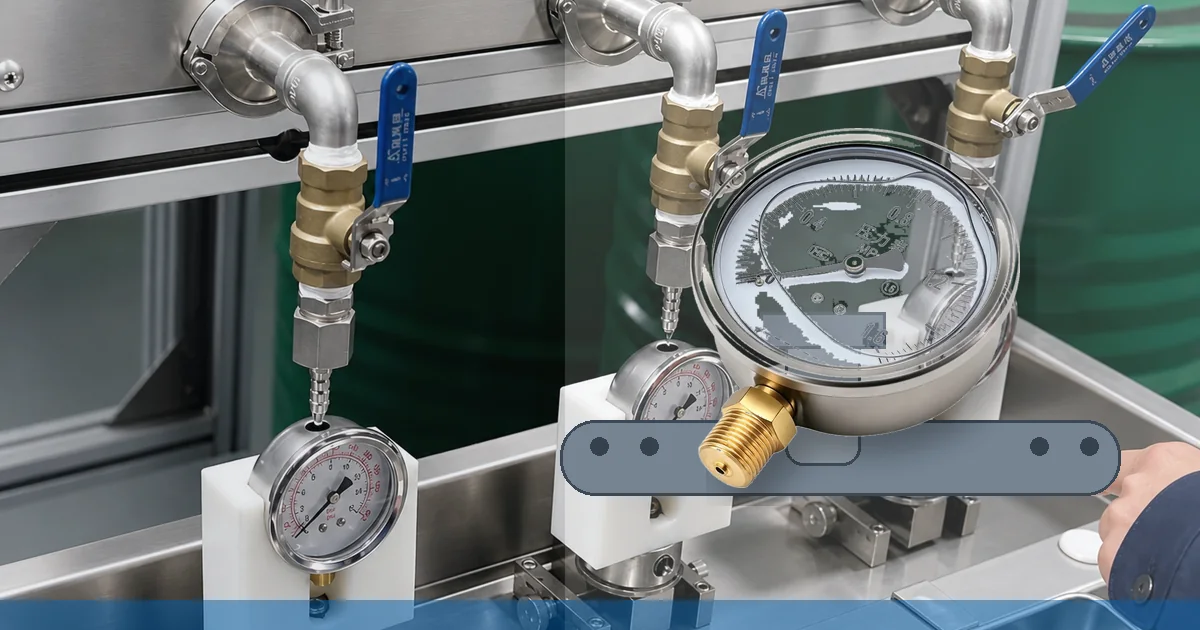
Selecting the correct pressure gauge requires evaluating the operational environment as much as the process parameters. A primary decision point is the choice between a standard dry case gauge and a liquid-filled gauge. While visually similar, their performance under dynamic conditions differs significantly. Liquid-filled gauges are engineered specifically to counteract the damaging effects of vibration and pulsation, which are common in industrial settings. This article provides the technical criteria for specifying the appropriate gauge type to ensure measurement accuracy, readability, and extended service life in demanding applications. For RFQ comparison, share the mounting point, vibration source, ambient temperature range, process medium, pressure range, dial size, thread and whether leakage of fill fluid would be unacceptable.

Dry vs liquid-filled pressure gauges is a selection question about readability, vibration, temperature and maintenance. A dry gauge has air inside the case around the movement. A liquid-filled gauge adds glycerin, silicone oil or another compatible fill fluid around the movement to damp pointer motion and reduce wear.
The sensing element is usually still a Bourdon tube for common industrial pressure ranges. The fill fluid does not make the gauge more accurate by itself, and it does not change the pressure rating of the sensing element. It mainly changes how the pointer and movement behave when the instrument is exposed to vibration, pulsation or mechanical shock.
Before choosing a filled case, confirm the process medium, ambient temperature, process temperature, case venting need, mounting position and whether leakage of fill fluid would create a safety or hygiene problem.
Compare Pressure Gauge Options for This ApplicationUse range, media, material and connection as the starting point.→The fill fluid should be selected for the operating environment, not treated as a universal upgrade.
| Gauge type | Best use | Limitation | RFQ check |
|---|---|---|---|
| Dry gauge | Stable pressure, indoor panels and clean static service | Pointer flutter under vibration or pulsation | Confirm vibration level and pressure stability |
| Glycerin-filled gauge | Pumps, compressors and general vibration damping | Viscosity changes in cold service and may not suit oxidizing media | Confirm ambient temperature and media compatibility |
| Silicone-filled gauge | Wider temperature variation and low-temperature service | Higher cost and still needs compatibility review | Confirm minimum/maximum ambient temperature |
Related reading: snubber selection and installation best practices.

Liquid filling helps most when the gauge body vibrates or when moderate pressure fluctuations make the pointer difficult to read. The viscous fluid slows rapid pointer movement, lubricates the internal movement and can reduce fatigue caused by continuous shaking on pumps, compressors, engines, hydraulic units and mobile equipment.
It does not solve every unstable reading. If the process pressure itself is pulsing sharply, a snubber, needle valve, remote mounting line or process-side pulsation dampener may be needed. If the real risk is overpressure, the answer may be range selection, a pressure limiter or a safety case rather than liquid fill.
For those related decisions, compare the pressure gauge snubber selection guide and the pressure gauge overpressure protection guide.
| Condition | Dry gauge | Liquid-filled gauge | Selection note |
|---|---|---|---|
| Stable clean air or water line | Usually sufficient | Often unnecessary | Choose readable range and suitable accuracy class first |
| Pump or compressor vibration | Pointer may flutter | Often improves readability | Check mounting support and isolation valve arrangement |
| Hydraulic power unit | May wear quickly | Common choice | Also check pressure spikes and test-port thread type |
| High ambient temperature | No fill expansion issue | Fill fluid and venting must be reviewed | Silicone may be considered where glycerin is unsuitable |
| Food, pharma or oxygen service | May be easier to justify | Only with compatible design and approval | Do not assume standard glycerin fill is acceptable |
For hydraulic service, review the hydraulic pressure gauge selection guide. For hygienic process lines, review the sanitary pressure gauge selection guide before using any filled case.
In many maintenance failures, the wrong conclusion is drawn because pointer motion is blamed on gauge quality alone. A dry gauge on a vibrating pump skid may be perfectly acceptable on a bench but unreadable in service. Conversely, a filled gauge can look stable while a hidden process pulse continues to stress the Bourdon tube. The useful RFQ question is therefore not only dry or filled, but what kind of motion the gauge must survive.
Send Range, Media and Connection for Engineer ReviewA short specification is enough to start a quote review.→Fill fluid expands and contracts with temperature. Many liquid-filled gauges require case venting or a pressure-compensating plug so internal case pressure does not shift the pointer or stress the window. If a filled gauge is installed in direct sun, near steam piping or in outdoor freezing conditions, the fill fluid and case design must be checked against the actual ambient and process temperature.
Glycerin is common for general industrial service, while silicone oil is often considered for wider temperature ranges. The final choice depends on the supplier design, medium, temperature, cleaning chemicals, safety requirements and whether fill-fluid leakage can be tolerated.
Installation still matters. A filled gauge can fail early if the thread is wrong, the gauge is used as a wrench point, the impulse line traps debris, or the range is too low for startup pressure. Review pressure gauge installation best practices before treating liquid fill as the only fix.
Case filling also affects service practice. Filled gauges may need a vent plug opened after installation, especially when shipped at one altitude and installed at another or when ambient temperature changes significantly. If the plug is left closed when venting is required, internal case pressure can bias the pointer. If it is left open in washdown, outdoor or dirty areas, contamination can enter. Follow the supplier instructions for the exact case design.
Request a Free QuoteOur engineers respond within 24 hours→When requesting a dry or liquid-filled pressure gauge, specify the process medium, normal pressure, maximum pressure, pressure pulsation, ambient temperature, process temperature, vibration source, dial size, connection thread, mounting orientation, wetted material and required accuracy class.
For clean stable service, a dry gauge may be simpler and easier to maintain. For vibrating equipment, a liquid-filled gauge may make local readings usable and extend movement life. For severe pressure pulses, corrosive media, hygienic lines, oxygen service or hazardous areas, final selection should be confirmed by the responsible engineer or project specification.
For accuracy and calibration context, compare the pressure gauge accuracy class guide and the pressure gauge calibration traceability guide.
For spare-parts standardization, avoid changing every gauge to a filled type without reviewing the service. Keep dry gauges where the reading is stable and the environment is clean; reserve liquid-filled versions for locations where vibration, pointer flutter or movement wear has been observed. This keeps inventory simple while still protecting instruments at high-risk points.
RFQ checklist: include pressure range, normal operating point, process media, wetted material preference, case material, dial size, thread connection, mounting position, quantity, certificates required and target delivery. These details let a supplier confirm whether a dry gauge, liquid-filled gauge, snubber, diaphragm seal, differential gauge or transmitter is the safer fit.
Save the related Manogauge guides for procurement and maintenance checks.
Comparison of filled and dry gauges for vibration, pulsation, reading stability and maintenance.
Move from dry-vs-filled selection to pump, compressor and hydraulic RFQs.
Choose a liquid-filled gauge when your application involves vibration, pressure pulsation, or frequent pressure spikes — common in pump outlets, compressors, and hydraulic systems. The fill fluid (glycerin or silicone oil) dampens pointer oscillation, extends gauge life by up to 5×, and maintains readability in harsh conditions.
Glycerin is the standard fill fluid, rated for −20 °C to +60 °C and suitable for most industrial applications including food-grade use. Silicone oil extends that range to −40 °C / +200 °C, making it the choice for outdoor installations, cryogenic service, or oxygen-system applications where glycerin is incompatible.
Standard glycerin-filled gauges are rated to +60 °C ambient. For higher temperatures, specify silicone oil fill (rated to +200 °C) or use a dry gauge with a capillary siphon assembly to keep the gauge body remote from the process heat.
A fill fluid leak indicates a cracked case window or damaged seal — usually caused by overpressure, UV aging, or chemical attack. Replace the gauge immediately; a partially-filled gauge loses its vibration damping and will fail prematurely. The fill fluid is not a process hazard but should not be released into food-grade or oxygen systems.
Yes. EN 837-1 covers both dry and liquid-filled Bourdon-tube gauges and specifies accuracy classes (0.1 to 4.0) applicable to both types. Manogauge liquid-filled models comply with EN 837-1 accuracy class 1.6 standard, with class 1.0 available on request.
No — field filling is not recommended. The case must be sealed under controlled conditions, and the fill fluid quantity must displace all air. Attempting to fill a dry gauge in the field typically traps air bubbles that cause pointer hysteresis and inaccurate readings. Always order pre-filled gauges from the factory.
Silicone fill is preferred for outdoor installations in cold climates. Standard glycerin thickens significantly below −10°C and can freeze at lower temperatures, causing pointer sluggishness or case cracking. Silicone fill remains fluid down to −60°C. For food-processing or pharmaceutical areas where glycerin contamination is a concern, silicone is also the safer choice. Glycerin is less expensive and adequate for indoor or temperature-controlled environments.
Specify a dry gauge for clean, static, non-pulsating service where fill-fluid contamination is a concern — compressed air lines, oxygen service, or food-contact applications with strict hygienic requirements. Dry gauges are also easier to inspect visually (no fill discoloration to distinguish from process contamination), and they weigh less. Fill-fluid gauges are generally preferred everywhere vibration, pulsation, or wide temperature swings occur.