
Accurate measurement of differential pressure (ΔP) is critical across industrial processes, from filter health and pump differential to semiconductor ultrapure water (UPW) loop monitoring. Selecting the correct differential pressure gauge requires matching DP range, static pressure rating, wetted materials, port connection, manifold arrangement and whether a local dial or transmitter output is required. For semiconductor UPW service, confirm wetted material compatibility, dead-leg risk, cleaning method and whether the instrument is only for utility monitoring rather than direct critical process validation.
1. Operating Principle and Design Variants
Differential pressure gauges operate by measuring the pressure difference between two distinct points in a process. The two primary operating principles are the two-process-connection Bourdon tube and the diaphragm differential element. Bourdon tube designs, typically featuring two C-shaped or helical tubes, are suitable for lower static pressures and offer robust mechanical indication. Each Bourdon tube is connected to one of the two pressure sources (high and low), and their independent deflections are mechanically linked to indicate the differential.
Diaphragm differential elements, conversely, utilize a flexible diaphragm or bellows assembly that deflects in response to the pressure difference across its two sides. This deflection is then translated into a mechanical reading. Diaphragm designs are particularly well-suited for applications requiring higher static line pressure ratings, often up to 600 bar, and can handle lower differential pressure ranges more sensitively. They are also less susceptible to damage from overpressure on one side, provided appropriate overpressure protection is integrated.
Manogauge offers both Bourdon tube and diaphragm-based differential pressure gauges, each optimized for specific performance envelopes. The choice between these variants depends on the required DP range, static line pressure, media compatibility, and desired accuracy class. Understanding these fundamental differences is crucial for proper instrument selection and reliable long-term operation in challenging industrial environments.
Flow and DP terminology can be cross-checked with ISO 5167 differential pressure flow measurement.
Compare Pressure Gauge Options for This ApplicationUse range, media, material and connection as the starting point.→2. Key Specifications: DP Range, Static Pressure, and Accuracy
When specifying a differential pressure gauge, three critical parameters must be carefully considered: the differential pressure (DP) range, the static line pressure rating, and the accuracy class. DP ranges typically span from very low measurements, such as 0-100 mbar, up to higher differentials like 0-10 bar. It is essential to select a gauge where the normal operating differential pressure falls within the middle 30-70% of the instrument's full scale to ensure optimal accuracy and longevity.
The static line pressure rating refers to the maximum pressure that can be applied simultaneously to both the high and low pressure ports without damaging the instrument. High-static models are available with ratings up to 600 bar, making them suitable for demanding applications in high-pressure systems. Exceeding this rating can lead to catastrophic failure. Always ensure the gauge's static pressure rating significantly exceeds the maximum expected process line pressure.
Accuracy is specified as a percentage of the full-scale range. Industrial standards like ASME B40.100 and EN 837-1 define various accuracy classes. For instance, ASME B40.100 typically specifies accuracy classes from Grade 4A (±0.1%) to Grade D (±5%), while EN 837-1 uses classes like Class 0.6 (±0.6%) or Class 1.0 (±1.0%). For most industrial applications, an accuracy of ±1.0% or ±1.6% of full scale is common, but critical applications, especially in safety instrumented systems (SIS), may require higher precision. Always verify the gauge's compliance with relevant industry standards.
For corrosive fluids, review 316L stainless steel vs. brass for corrosive media.
Quick differential pressure gauge selection table
Use the table as a screening tool, then verify the actual process limits and connection details on the project data sheet.
| Application | Primary reading | Selection focus | Do not infer |
|---|---|---|---|
| Filter or strainer | Clean-to-dirty pressure difference | Normal DP near the readable middle of span; include a defined changeout threshold | DP alone does not prove filter media condition or flow rate |
| Pump or hydronic circuit | Supply-to-return or suction-to-discharge difference | Static pressure rating, liquid compatibility and isolation at both taps | A gauge pair does not replace the pump curve or commissioning record |
| Gas or low-DP process | Small pressure difference across a controlled path | Low-range resolution, temperature effect, leakage control and response time | A stable pointer does not prove that an impulse line is open |
3. Wetted Materials and Media Compatibility
The selection of wetted materials is paramount for ensuring the longevity and reliability of a differential pressure gauge, especially when dealing with aggressive process media. The wetted parts are those components that come into direct contact with the process fluid. Common standard materials include 316L Stainless Steel, which offers excellent corrosion resistance for a wide range of industrial fluids, including many acids, alkalis, and potable water systems. It is a workhorse material for general-purpose applications.
For highly corrosive or extreme temperature applications, specialized materials are necessary. Hastelloy C276 is a nickel-molybdenum-chromium superalloy renowned for its exceptional resistance to a broad spectrum of severe corrosive environments, including oxidizing and reducing acids, chlorides, and wet chlorine gas. This makes it ideal for chemical processing, petrochemical, and pharmaceutical industries where standard stainless steel would fail.
When dealing with extremely aggressive or sticky media, PTFE-lined wetted parts can provide an inert barrier, preventing corrosion and material buildup. PTFE (Polytetrafluoroethylene) offers superior chemical resistance to almost all industrial chemicals and solvents. Other materials like Monel, Inconel, or Tantalum may also be specified for highly specialized applications. Always consult a chemical compatibility chart and consider process temperature, concentration, and potential contaminants when selecting wetted materials to prevent premature instrument failure and ensure process integrity.
Filter monitoring examples continue in membrane filtration DP monitoring for wastewater.
Send Range, Media and Connection for Engineer ReviewA short specification is enough to start a quote review.→4. Application Guide: Filter ΔP, Flow, Level, and Pump Monitoring
Differential pressure gauges are versatile instruments with critical roles across various industrial applications. A primary use case is filter monitoring, where the ΔP across a coalescer, strainer, or filter element indicates its loading status. An increasing differential pressure signals that the filter is becoming clogged and requires cleaning or replacement, preventing process downtime and ensuring product quality.
In pump health monitoring, differential pressure gauges can be used to compare suction versus discharge pressures. An abnormal ΔP can indicate issues such as cavitation, impeller wear, or blockages, allowing for proactive maintenance. For flow measurement, ΔP gauges are integral components in conjunction with primary flow elements like orifice plates, Venturi tubes, or flow nozzles. The differential pressure generated across these restrictions is directly proportional to the square of the flow rate, enabling accurate flow calculation.
Level measurement in sealed tanks is another key application. By measuring the differential pressure between the bottom and top of a sealed tank, the liquid level can be accurately determined, compensating for variations in headspace pressure. This is particularly useful for pressurized tanks or those containing volatile liquids. Furthermore, differential pressure gauges are often specified for SIL-rated safety loops (Safety Integrity Level), where their reliability and accuracy contribute to the overall safety function, requiring rigorous documentation and certification to standards like IEC 61508/61511.
Controlled-room applications are covered in cleanroom differential pressure monitoring in pharma GMP.
Related selection detail: DP Gauge for Filter Monitoring: Range, Alarm and Clogging Guide and Chilled Water DP Monitoring Guide.
5. Installation, Manifold Valves, and Commissioning Best Practices
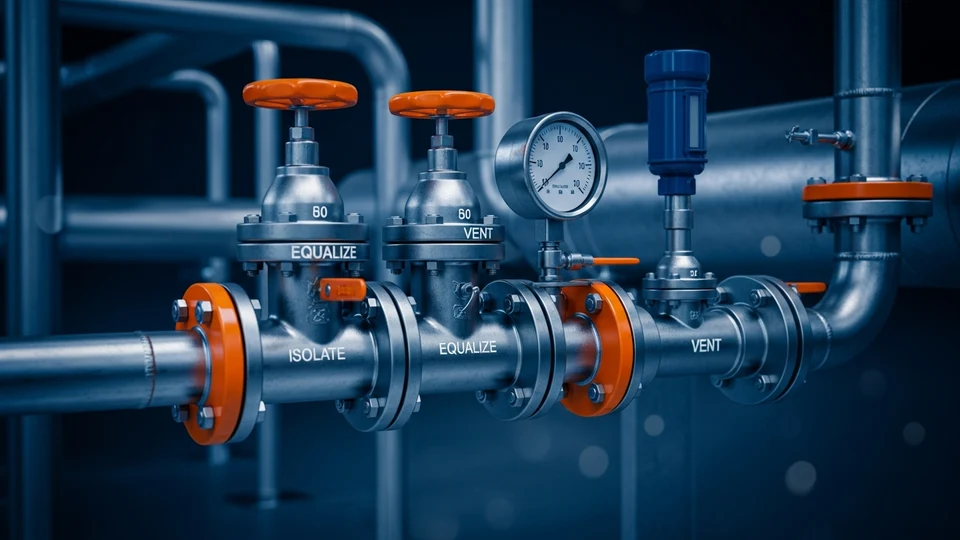
Proper installation and commissioning are crucial for the accurate and safe operation of a differential pressure gauge. Manifold valve arrangements are essential for safe isolation, zeroing, and maintenance. Common types include:
- 2-valve manifold: Used for basic isolation and equalization.
- 3-valve manifold: Most common, featuring two block valves (isolating high and low pressure) and one equalizing valve. This allows for safe zeroing and removal of the instrument.
- 5-valve manifold: Adds two drain/vent valves to the 3-valve configuration, facilitating impulse line purging and calibration.
During startup, always ensure the equalizing valve is open before slowly opening the high and low block valves to prevent sudden pressure surges that could damage the differential element. Once pressures are equalized, close the equalizing valve. Impulse lines (tubing connecting the process to the gauge) should be kept as short as possible, sloped to prevent liquid traps in gas service or gas traps in liquid service, and filled with an appropriate fill fluid (e.g., water, glycol, silicone oil) if the process fluid is corrosive, viscous, or at extreme temperatures. This protects the instrument and ensures accurate pressure transmission.
For gas service, the impulse lines should slope upwards from the tap to the gauge; for liquid service, they should slope downwards. Regular calibration and verification, especially for instruments in SIL-rated safety loops, are vital to maintain performance and compliance. Always refer to the manufacturer's specific installation instructions and relevant industry standards like EN 837-1 and ASME B40.100.
Manifold and mounting practices should be checked against pressure gauge installation best practices.
RFQ checklist: include pressure range, normal operating point, process media, wetted material preference, case material, dial size, thread connection, mounting position, quantity, certificates required and target delivery. These details let a supplier confirm whether a dry gauge, liquid-filled gauge, snubber, diaphragm seal, differential gauge or transmitter is the safer fit.
6. Differential Pressure Gauge Selection Decision and Limits
The final differential pressure gauge selection should be made from the complete measurement point, not from the differential range alone. Record the clean and loaded pressures, maximum static pressure on either port, expected flow, process temperature, medium composition, connection position and the reading required by the operator. A filter gauge is normally used to show loading between an upstream and downstream tapping point; it does not by itself establish the filter manufacturer's changeout limit. That limit must be checked against the actual flow and the equipment data sheet.
Check the worst credible condition before approving the instrument. A blocked impulse line can create a false stable reading, while a valve opened in the wrong sequence can expose one side of the sensing element to a damaging pressure step. Use a suitable manifold or isolation arrangement where the process requires controlled equalisation, venting or calibration access. For dirty, crystallising or viscous media, consider flushing provisions or diaphragm isolation, but confirm that the added seal and fill system will not make response too slow for the control or alarm function.
Do not use a differential pressure gauge to infer flow, level or filter life without validating the relationship for the specific installation. Flow-to-pressure relationships depend on density, viscosity, geometry and operating point; tank level also depends on the reference-leg arrangement and fluid density. Where a transmitter, alarm contact or remote trend is required, specify the output and proof-test method separately from the local dial. The responsible engineer must confirm the final range, static rating, wetted materials, overpressure protection and installation against the P&ID and current supplier data sheet.
Range is only one part of differential pressure gauge selection. Before choosing a DP gauge, state the normal clean and dirty-side pressures, static line pressure, expected differential, transient differential and the maximum allowable overpressure on either port. A filter gauge can show rising restriction, but it cannot by itself prove filter media condition, flow quality or the absence of a bypass leak. Confirm port orientation, equalising/isolation valves, impulse-line routing and the required response time against the actual P&ID.
Key takeaways
- Match the differential pressure gauge operating principle (Bourdon tube vs. diaphragm) to the application's static pressure and DP range requirements.
- Always select a gauge with a static line pressure rating significantly higher than the maximum expected process pressure.
- Choose wetted materials like 316L SS, Hastelloy C276, or PTFE-lined components based on media corrosivity and temperature.
- Utilize 3-valve or 5-valve manifolds for safe isolation, equalization, and zeroing of differential pressure gauges.
- Ensure proper impulse line installation (slope, fill fluid) and follow a strict commissioning sequence to prevent instrument damage.
Related buyer pages
Diaphragm pressure gauge manufacturerUse diaphragm or isolated designs for corrosive, viscous or clogging differential pressure services.
Sanitary pressure gauge manufacturerReview flush diaphragm, 316L wetted parts and clean-service documentation for UPW-adjacent utility points.
Related products
- Diaphragm Pressure Gauge - Type 1 (ZX-05-1) — 0–60 kPa
- Isolating-Diaphragm Gauge - Radial Type 1 (ZX-04-R1) — 0–60 MPa
Related reading
- Filter Differential Pressure Gauge: Range, Alarm, Changeout
Choose a filter differential pressure gauge from clean DP, changeout DP and flow: DP span, alarm setting, port layout, wetted materials and cleaning limits.
- Cleanroom Differential Pressure: 10-15 Pa Cascade & Alarms
Cleanroom differential pressure monitoring: the 10-15 Pa cascade, airlock and HEPA points, low-range DP gauge choice, alarm limits and calibration records.
- District Heating Pressure Gauge: Range & Temperature
Select district-heating gauges for primary and secondary loops by pressure range, hot-water temperature, strainer DP points and siphon needs.
- Pressure Relief Valve Gauge Selection: Range and Placement
Size a relief valve pressure gauge around operating and set pressure, choose where the gauge belongs, and check backpressure, rupture discs and vibration.
- Biogas Pressure Gauge: H2S, Condensate & Range Guide
How to choose a biogas pressure gauge for digesters and biomethane skids: check H2S corrosion, condensate, low-pressure range, materials and installation.
Frequently asked questions
What is the difference between a standard pressure gauge and a differential pressure gauge?
A standard pressure gauge measures absolute or gauge pressure relative to atmosphere or a vacuum. A differential pressure gauge, conversely, measures the pressure difference between two distinct points, providing insight into flow, level, or filter status rather than absolute system pressure.
Why is the static line pressure rating important for a differential pressure gauge?
The static line pressure rating indicates the maximum pressure the gauge can withstand on both its high and low ports simultaneously without damage. Exceeding this can lead to catastrophic failure, even if the differential pressure itself is within range, compromising safety and process integrity.
When should I use a 3-valve manifold with a differential pressure gauge?
A 3-valve manifold (two block valves, one equalizing valve) is recommended for most industrial differential pressure gauge installations. It allows for safe isolation of the gauge from the process, equalization of pressure across the sensing element for zeroing, and safe removal for maintenance or calibration.
What wetted materials are best for highly corrosive media?
For highly corrosive media, Hastelloy C276 offers excellent resistance to a wide range of aggressive chemicals. For extremely aggressive or sticky media, PTFE-lined wetted parts provide an inert, non-stick surface, preventing corrosion and buildup, ensuring long-term reliability.
How does a differential pressure gauge help with filter monitoring?
By measuring the pressure difference across a filter element, a differential pressure gauge indicates its loading. As the filter collects particulates, the ΔP increases, signaling that the filter is becoming clogged and requires cleaning or replacement to maintain optimal process flow and efficiency.
Can a differential pressure gauge be used for semiconductor UPW monitoring?
A differential pressure gauge can be used on UPW utility monitoring points such as filters, resin beds or skid pressure-loss checks, but the final specification must confirm wetted material, cleaning method, dead-leg risk and contamination limits. For critical semiconductor water quality validation, the gauge is a maintenance indication device and should not replace the fab's validated analytical instruments.
What static line pressure rating should be specified for a DP gauge on a 40 bar water system?
The static (line) pressure rating must cover the highest pressure applied to either port in isolation, not just the differential reading. On a 40 bar system, specify a DP gauge rated for at least 60–80 bar static working pressure (1.5×–2× maximum operating line pressure). Verify that the rating covers the asymmetric load case: one port at line pressure, the other vented to atmosphere during commissioning or one-side isolation.
Can a 3-valve manifold prevent DP gauge overpressure on startup?
Yes. Open the equalizer valve first to balance both ports before cracking the block valves. This prevents a sudden line-pressure slug reaching one port while the other is at atmospheric pressure. Once both block valves are open, close the equalizer to restore differential measurement. The equalizer also allows in-service zero checks without removing the gauge from the process.