Pressure Gauge Material Selection Guide
Wetted parts, case, window, movement and connection material notes for industrial gauge buyers.
The selection of wetted part materials—principally the Bourdon tube and socket—is a critical decision that dictates a pressure gauge's service life, accuracy, and safety. While brass offers a cost-effective solution for benign media, 316L stainless steel provides the corrosion resistance necessary for a broad range of industrial processes. Understanding the specific failure mechanisms of each alloy in different chemical environments is essential for proper instrument specification and preventing premature failure, process contamination, or catastrophic leaks. This analysis provides a technical basis for choosing between these common materials and identifies when higher-performance alloys are required.
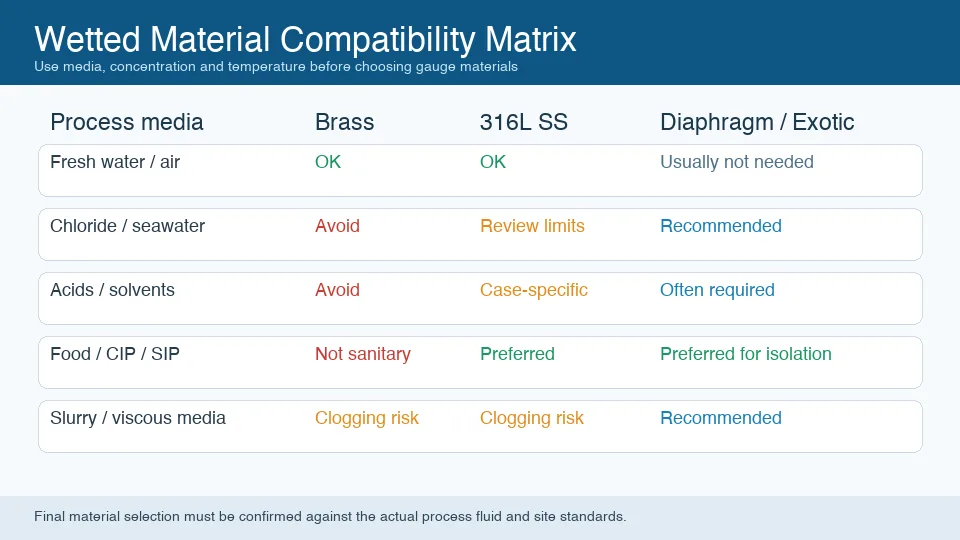
Pressure gauge wetted parts are the components that touch the process medium, usually the Bourdon tube, socket, diaphragm seal fill boundary or process connection. Brass wetted parts are economical for clean air, mild water and many non-corrosive utility services. 316L stainless steel wetted parts are selected when corrosion, washdown, food contact, condensate, ammonia risk or chloride exposure makes copper alloy unsuitable.
The choice should follow the actual medium, concentration and temperature, not only the pressure range. A gauge that is accurate on the bench can fail early if the socket or Bourdon tube is attacked by the process fluid. For severe media, a diaphragm seal with special wetted material may be safer than exposing the gauge movement directly.
Browse Our Pressure Gauge Catalog →Explore 143+ industrial gauge models→Material choice should start with the process medium and cleaning fluid, then be checked against temperature, concentration and exposure time.
| Medium or environment | Brass gauge risk | 316L stainless gauge risk | Better RFQ wording |
|---|---|---|---|
| Clean water or mild air | Often acceptable when corrosion risk is low | Usually acceptable but may be higher cost | Confirm water chemistry and connection material |
| Seawater or chloride-rich water | Dezincification and corrosion risk | Chloride pitting risk at higher concentration or temperature | Ask for compatible wetted material or diaphragm seal |
| Ammonia service | Generally avoid copper alloys | Often preferred, but system requirements still control | State R717 ammonia, pressure range and cleaning method |
| CIP/SIP or aggressive chemicals | Usually unsuitable | May still need special alloy or seal | Provide chemical name, concentration, temperature and exposure time |
Related reading: ammonia refrigeration pressure monitoring and sanitary pressure gauge selection.
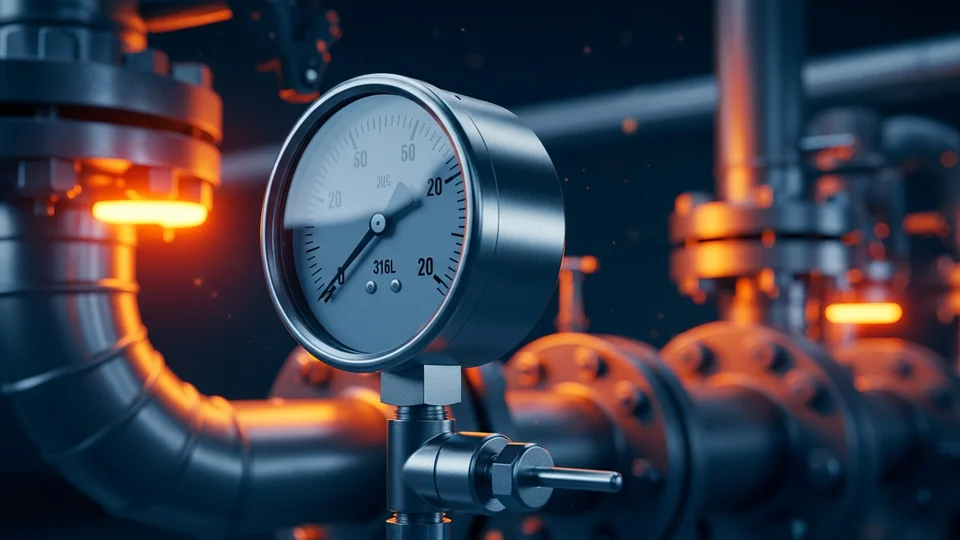
Material compatibility is service-specific. Brass can be acceptable for dry compressed air and many HVAC water loops, but it is usually avoided for ammonia, seawater, strong acids, caustic cleaning, deionized water and sanitary product contact. 316L stainless steel improves resistance in many industrial and food-grade services, but it is not universal. High chlorides, strong acids, high temperature and stagnant crevice conditions can still create pitting or stress corrosion risk.
| Service | Typical concern | Wetted-part direction |
|---|---|---|
| Compressed air | Condensate, oil carryover, outdoor humidity | Brass or 316L depending on plant standard and corrosion risk |
| Ammonia refrigeration | Copper alloy incompatibility | Use stainless wetted parts and confirm local safety requirements |
| Food, beverage, CIP | Cleaning chemicals, hygiene, crevices | Prefer 316L and sanitary diaphragm construction where product contact exists |
| Seawater or brine | Chloride pitting | 316L may be insufficient; review diaphragm seal alloy options |
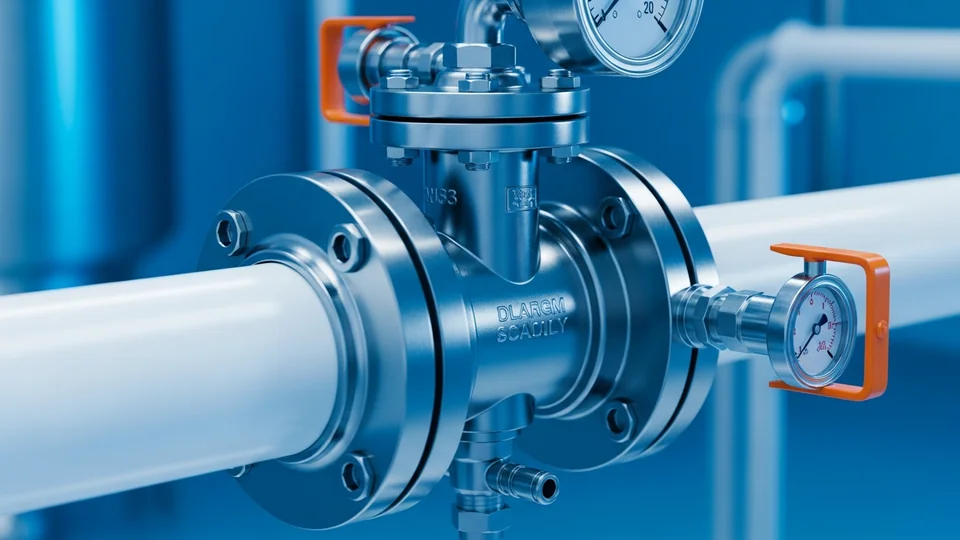
PREN, or pitting resistance equivalent number, is a comparative index used to discuss chloride pitting resistance in stainless steels. It is useful as a screening concept, but it does not prove field suitability by itself. Temperature, oxygen, crevices, deposits, cleaning chemicals and exposure time can change corrosion behavior.
For CIP and SIP utilities, 316L stainless steel is often a practical baseline, especially when the gauge is separated from product by a hygienic diaphragm seal. Confirm elastomer, fill fluid, surface finish, clamp size and cleaning temperature before approving the instrument. If the medium is highly corrosive, use a diaphragm seal with a verified wetted material such as Hastelloy, Monel, tantalum or PTFE-lined construction where appropriate.
Request a Free QuoteOur engineers respond within 24 hours→A useful RFQ should state the medium, concentration, temperature, normal and maximum pressure, cleaning chemicals, connection thread, dial size, mounting direction, wetted material, case material and whether a diaphragm seal is required. Do not ask only for “stainless gauge” or “brass gauge”; specify which parts must be stainless and whether the case, socket, Bourdon tube and process connection are all included.
For adjacent decisions, review the ammonia refrigeration pressure gauge selection, sanitary pressure gauge food and beverage guide and pressure gauge thread connection guide.
Save the related Manogauge guides for procurement and maintenance checks.
Wetted parts, case, window, movement and connection material notes for industrial gauge buyers.
316L flush diaphragm gauges with Ra ≤ 0.8 µm for food, dairy and pharmaceutical applications.
Stainless steel pressure gauge manufacturer304/316L wetted parts for corrosion resistance in chemical, marine and water treatment service.
316L SS contains 2–3% molybdenum, which provides superior resistance to chloride pitting and crevice corrosion compared to brass. Brass alloys are prone to dezincification in chloride-containing media and stress-corrosion cracking in ammonia atmospheres. 316L maintains mechanical integrity in a wider range of industrial chemicals.
Concentrated hydrochloric acid (>5%), hydrofluoric acid, bromine, and hot concentrated sodium hydroxide are among the most aggressive media for 316L SS. For these services, specify Hastelloy C-276, Monel 400, or tantalum wetted parts depending on the specific chemical.
Not recommended. Seawater (chloride ~19,000 ppm) causes rapid dezincification of brass alloys, leading to porous, weakened fittings and potential gauge failure. Specify 316L SS or duplex stainless steel for seawater and brackish water applications.
Standard 316L SS Bourdon tubes are rated to approximately 200°C continuous service. Above this temperature, creep and oxidation degrade accuracy. For high-temperature steam (>200°C), specify a siphon tube and confirm with the manufacturer on the specific alloy heat treatment.
Yes. The socket (process connection) is the first point of contact with media and experiences the most stress from pressure cycling and thread engagement. Always specify the same corrosion-resistant alloy for both the socket and Bourdon tube. A 316L tube on a brass socket will fail at the socket first.
Brass (copper-zinc alloy) is susceptible to stress corrosion cracking in ammonia and chloride environments. As a practical guideline, avoid brass wetted parts where chloride concentration exceeds 200 ppm in process contact, or where any ammonia is present in the media. For seawater, brackish water, or chlorinated process streams, specify 316L stainless steel or a higher-alloy alternative.
The 'L' (low-carbon) designation limits carbon content to 0.03% maximum. Standard 316 SS can undergo sensitization at heat-affected zones during welding — chromium carbide precipitates and depletes corrosion resistance near welds. 316L avoids this, maintaining full corrosion resistance in welded Bourdon tube and socket assemblies. For weld-free machined parts, the corrosion performance of 316 and 316L is nearly identical.